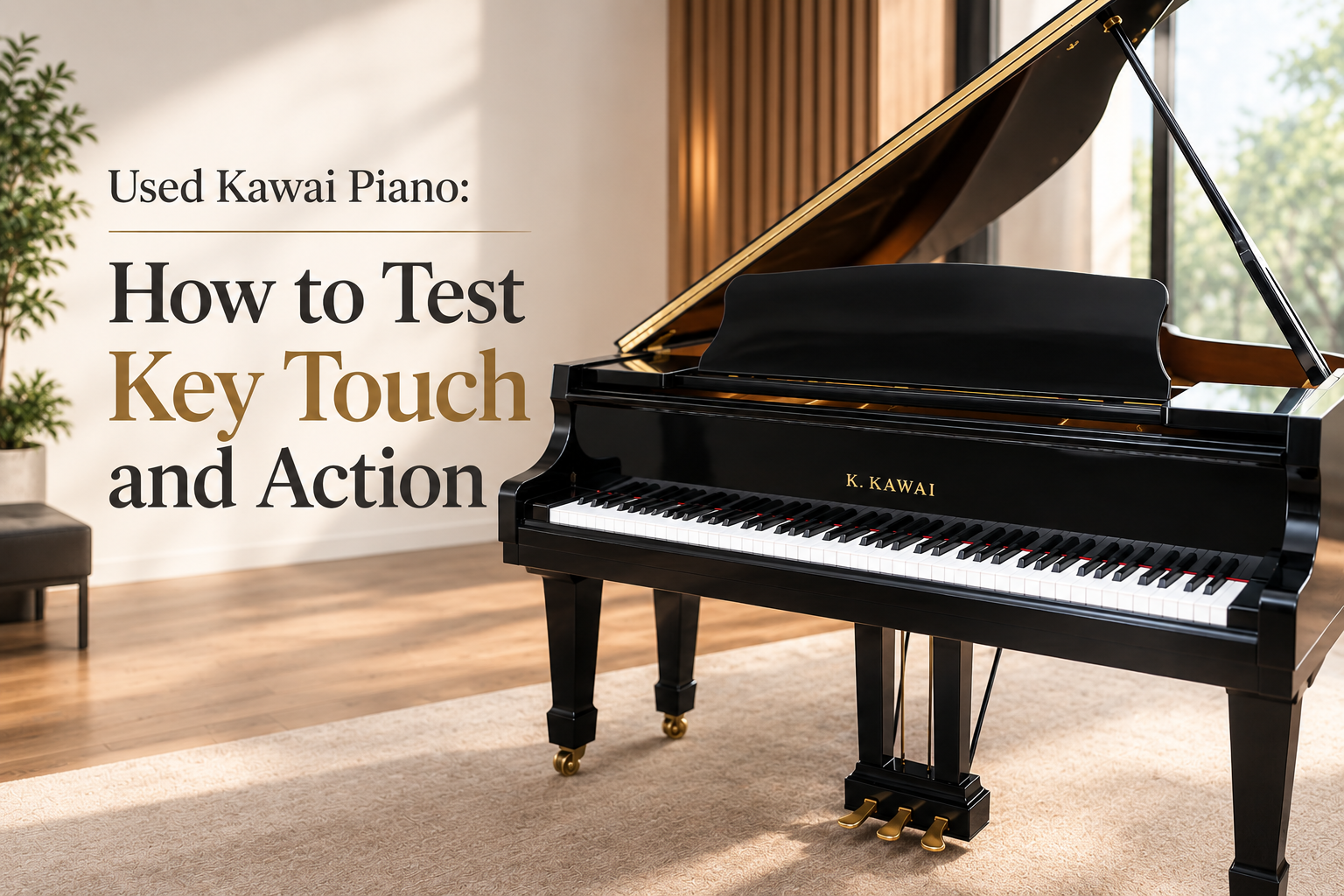
Used Kawai Piano: How to Test Key Touch and Action
When choosing a used Kawai piano, one of the most important things to evaluate is how the piano feels when you play it. A used piano has already experienced years of playing, and its key touch and action can tell you a great deal about its condition.
While the cabinet, finish and overall appearance are easy to inspect, problems inside the action are not always visible. A piano may look well cared for but have uneven keys, sluggish repetition or worn action components.
This is why testing the key touch and action should be an essential part of choosing a used Kawai piano. The goal is not simply to find a piano that produces sound, but to understand how well the instrument responds after years of use.
Why Key Touch Is Important When Buying a Used Piano
Key touch describes how the keys feel when they are pressed. You can feel whether a key moves smoothly, whether it feels unusually heavy or light and how quickly it returns after being released.
The action is the mechanical system underneath the keys that transfers your finger movement to the hammers. It contains many moving components, along with felt and wooden parts that can gradually wear through regular use.
In a used piano, the condition of these components depends on several factors:
- How frequently the piano was played
- How long it has been in service
- Whether it was regularly maintained
- Whether the action has been regulated
- Whether worn parts have been replaced
- The environment in which the piano was kept
Therefore, the same Kawai model can feel very different from one used instrument to another.
Start by Testing the Entire Keyboard
When you visit a used piano, do not test only a few keys in the middle of the keyboard.
Start from the bass and slowly work your way toward the treble. Press each key individually and concentrate on how it feels.
Look for keys that:
- Feel noticeably heavier or lighter
- Stick during movement
- Return slowly
- Do not return completely
- Feel rough or uneven
- Make unusual mechanical sounds
- Respond differently from neighbouring keys
This simple test can reveal differences that may not be obvious when you immediately start playing a song.
A used piano should not necessarily feel exactly the same across every register, but individual keys should not feel unexpectedly different without a reasonable explanation.
Compare Neighbouring Keys
After playing through the keyboard, compare several keys next to each other.
Use similar finger pressure and play them one after another. Pay attention to whether the resistance and movement feel reasonably consistent.
This is particularly useful when inspecting a used piano because wear can develop unevenly.
For example, a piano that was frequently played by one person may show more wear in certain areas of the keyboard. A piano previously used in a teaching studio may have experienced much more playing than one that spent most of its life in a private home.
Uneven touch does not automatically mean that the piano is in poor condition. It may be related to regulation or relatively minor servicing. However, it is something a buyer should identify before purchasing.
Test How the Keys Return
A key should return smoothly after you release it.
Press a key slowly, release it and watch how it comes back. Then repeat the test at a faster speed.
A sluggish or slow-returning key can become particularly noticeable when playing repeated notes or fast passages.
Try this test on different parts of the keyboard. If several keys appear slow, the issue may involve the action rather than a single key.
On a used piano, this is an important distinction. One problematic key may require a simple adjustment, while widespread sluggishness could indicate more extensive action servicing.
Test Repeated Notes
Repeated notes are another useful way to assess a used piano’s action.
Choose several keys and play each one repeatedly. Start slowly and gradually increase the speed.
Listen and feel for whether the key is ready for the next note.
If a key feels slow to recover, does not repeat smoothly or produces inconsistent results, make a note of it.
You can also try repeated notes in the bass, middle and treble sections. This gives you a better idea of whether the response is consistent throughout the instrument.
This test is especially useful for students and more advanced pianists who regularly encounter fast passages and repeated notes in their repertoire.
Test Very Soft Playing
A used piano should not only be tested by playing loudly.
Try playing individual notes as softly as possible. Then play a quiet scale or a short musical phrase.
Listen carefully to how the keys respond to gentle finger pressure.
This can reveal differences that are difficult to notice during normal playing. If some notes respond easily while others feel difficult to control, the action may need regulation or further inspection.
Good control at low volume is particularly important for pianists who want to develop dynamic sensitivity and expressive playing.
Test Stronger Dynamics
After testing soft playing, gradually increase the playing force.
You do not need to strike the keys aggressively. Instead, play a familiar passage through a wider dynamic range.
Pay attention to whether the action remains predictable as you increase the pressure.
When buying a used Kawai piano, the question is not simply whether the piano can produce a loud sound. You should also consider whether your fingers can control the change from soft to loud comfortably.
A responsive action should allow you to shape the music rather than constantly adapting to uneven keys.
Listen for Unusual Sounds
Your ears can also help you evaluate the action.
While playing, listen for clicking, knocking, squeaking, rattling or other sounds that appear to come from individual keys.
Some mechanical noise is normal in an acoustic piano, particularly when you play close to the instrument. The concern is when one key sounds noticeably different from the others.
Try pressing the key slowly several times. If the sound remains, mention it to the seller or have a technician investigate it.
Do not automatically assume that an unusual noise means an expensive repair. Some problems may be relatively simple to correct. The important thing is to identify the issue before you commit to buying the piano.
Consider How the Used Piano Was Maintained
The piano’s maintenance history is particularly important when evaluating key touch.
Ask whether the piano has been regularly tuned and serviced. Find out whether the action has previously been regulated or repaired.
If the seller knows when the piano was last serviced, ask what work was carried out.
Useful questions include:
- When was the piano last tuned?
- Has the action been regulated?
- Have any action parts been replaced?
- Has the piano been refurbished?
- How frequently was it played?
- Was it used at home or in a teaching environment?
- Where was the piano stored?
A clear maintenance history does not guarantee perfect condition, but it gives you valuable information about what you are buying.
Used Piano Age vs. Actual Condition
Buyers often assume that a newer used piano will automatically have better key touch than an older one. This is not always the case.
The age of a used Kawai piano is only one part of the picture. How the piano was used, maintained and serviced can be just as important.
An older Kawai piano that has received consistent servicing may feel smoother and more responsive than a newer instrument that has experienced heavy use without proper maintenance.
Used Kawai KU and BL pianos can offer good value, but their key touch can vary significantly depending on age and condition. Well-maintained examples can have a smooth, responsive and consistent touch, while heavily played instruments may develop uneven resistance, sluggish key return or worn action parts. When considering a used KU or BL, test the keys across the entire keyboard rather than judging the touch by the model or age alone.
Instead of asking only, “How old is this piano?”, ask:
“How has this piano been used, and what condition is it in today?”
This gives you a much more realistic way to evaluate a used piano and its playing condition.
Regulation Can Affect Key Touch
If the keys feel uneven, the piano may not necessarily need major repairs.
Over time, the action can require regulation as components wear and adjustments change. Proper regulation can help restore consistency and improve the relationship between the keys and the action.
However, regulation cannot correct every problem. If action components are significantly worn or damaged, replacement or more extensive restoration may be necessary.
This is why buyers should avoid making repair assumptions based only on how a piano feels during a short test.
Think About the Piano’s Previous Environment
A used piano’s previous environment can also affect its condition.
For buyers in Malaysia, warm and humid conditions are an important consideration. Wood and felt components can be affected by unsuitable environmental conditions over time.
Ask where the piano was kept and whether it was exposed to direct sunlight, excessive moisture or major environmental changes.
A used piano with a stable storage history and regular maintenance can be a more reassuring purchase than one with an unclear background.
Have the Used Kawai Piano Professionally Inspected
Testing the piano yourself is useful, but it should not replace a professional inspection.
A qualified piano technician can examine the action and determine whether unusual touch is caused by normal adjustment, regulation issues, component wear or more serious problems.
This is particularly valuable when buying an older used Kawai piano or an instrument described as refurbished.
A technician can also help you understand what servicing the piano may require after purchase. This allows you to consider the piano’s actual condition rather than making a decision based solely on its appearance or asking price.
Final Thoughts
When choosing a used Kawai piano, key touch and action should be among your high priorities.
Take your time when testing the instrument. Play every key, compare neighbouring keys, check how quickly they return and test repeated notes. Try both very soft and stronger playing, and listen carefully for unusual mechanical sounds.
More importantly, look beyond the piano’s age and appearance. A used piano has a history, and its previous use, maintenance, regulation and storage environment can all influence how it feels today.
Kawai has produced many respected acoustic pianos, but the condition of the individual used instrument is what matters when you are deciding whether to buy.
For anyone searching for a used Kawai piano in Malaysia, a careful key touch test combined with a professional inspection can provide much greater confidence. Instead of choosing a piano simply because it looks good or carries a familiar model name, you can evaluate how the instrument actually performs and whether it is suitable for your playing needs.