Used Yamaha Piano: How to Choose One for Different Skill Levels
Choosing a used Yamaha piano is not simply about finding the newest or most expensive instrument available. The right piano should match the player’s skill level, playing goals, available space and budget.
For beginners, a piano with a comfortable and reliable action can make learning easier. Intermediate players may need greater responsiveness and dynamic control, while advanced pianists often pay closer attention to touch, tone and overall performance.
Yamaha has produced a wide range of acoustic pianos over the years, which means the used market offers options for different types of players. However, when buying used, the condition of the individual piano is just as important as the model.
Choosing a Used Yamaha Piano for Beginners
For someone learning piano for the first time, the most important factors are consistent key touch, reliable action and a comfortable playing experience.
Beginners do not necessarily need a large or expensive piano. A well-maintained compact Yamaha upright can provide a good foundation for developing proper technique and musical habits.
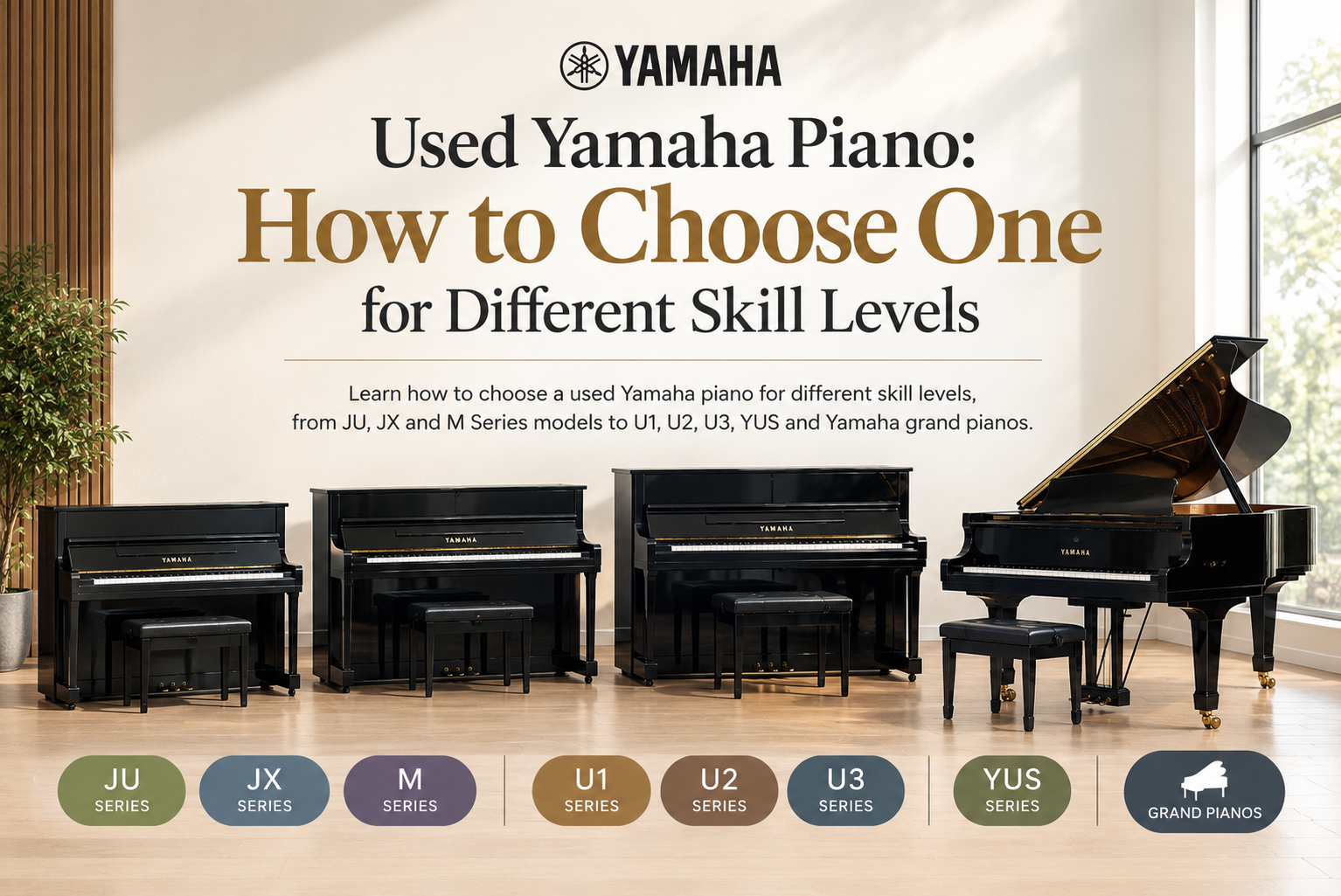
The Yamaha JU109 is a practical option for beginners who need a compact piano. At 109 cm high, it is designed with an emphasis on compactness, making it suitable for homes where space is limited. The JX113 series provides a slightly larger 113 cm cabinet and can offer greater tonal depth while remaining relatively compact.
The Yamaha M Series, including models such as the M2 and M3, can also suit beginners and developing players. Yamaha positions the M Series as high-quality upright pianos with a furniture-oriented design, making them suitable for home environments where appearance and acoustic performance are both important.
The Yamaha U1 is another versatile choice. Although it can be suitable for beginners, its playing capabilities can support a player well beyond the early stages of learning.
When viewing a used Yamaha piano, beginners should pay attention to:
- Consistent resistance across the keyboard
- Keys that return smoothly
- No sticking or unusual noises
- Pedals that operate properly
- A clear and balanced sound
- A piano that has been reasonably maintained
A used Yamaha can be particularly attractive for beginners because it may provide the experience of playing an acoustic piano at a lower cost than purchasing a comparable new instrument.
However, avoid choosing based purely on price. A cheaper piano that requires extensive servicing may ultimately cost more than a slightly more expensive instrument in better condition.
For students in Malaysia preparing for piano examinations, a 121 cm upright piano is considered the standard piano height for exam requirements, so choosing the right used Yamaha piano is important. Take the time to compare the options, check the piano’s condition and choose wisely.
Choosing a Used Yamaha Piano for Intermediate Players
As players progress, their expectations of the instrument usually increase. Intermediate pianists begin to explore greater dynamic range, faster passages, more complex articulation and different styles of music.
At this stage, key touch and action responsiveness become increasingly important.
An intermediate player should test whether the keys respond consistently when playing both softly and forcefully. Try scales, chords, repeated notes and passages that require changes in dynamics.
The Yamaha U1 can be an excellent option for this stage because it provides room for the player to continue developing without immediately needing to upgrade. The U2 can also appeal to intermediate players looking for a larger upright, while the U3 offers a taller cabinet and greater tonal presence for players moving into more demanding repertoire.
Selected Yamaha YUS Series models can also be considered by intermediate players who are becoming more particular about touch, tonal response and expressive control. Yamaha describes the YUS range as providing a broad tonal palette and a high level of expressive capability.
When considering a used Yamaha, intermediate players should look for:
- Even key touch across the keyboard
- Good repetition and key return
- Responsive action
- Clear tonal differences between soft and loud playing
- Stable tuning
- Minimal excessive action noise
- Evidence of regular maintenance
This is also the stage where players may want to consider the size and design of the instrument more carefully. A taller upright may provide greater tonal presence, although the condition of the individual piano remains critical.
Choosing a Used Yamaha Piano for Advanced Players
Advanced pianists tend to be more sensitive to differences in touch, tonal colour and dynamic control. For these players, the piano needs to respond accurately to technique and musical interpretation.
When testing a used Yamaha piano, advanced players should spend time playing across the entire keyboard.
Try very soft notes, strong chords, rapid repetitions, scales and expressive passages. Listen for whether the tone remains balanced from bass to treble and whether the action responds predictably to changes in playing pressure.
The Yamaha U3 can be a strong choice for advanced home pianists who prefer an upright. At 131 cm, it is the tallest model in Yamaha’s current U Series lineup and is designed to provide greater expressiveness and playability.
The Yamaha YUS Series is another option for advanced players. Yamaha highlights its refined tonal palette, high-quality materials and detailed voicing, making it particularly relevant to experienced pianists looking for greater expressive control.
For pianists with sufficient space and budget, a used Yamaha grand piano can provide another level of tonal and expressive capability. Yamaha’s grand range includes models such as the G and C Series, which can be considered by advanced players depending on their performance requirements.
Advanced players should pay attention to:
- Fine differences in key resistance
- Repetition speed
- Action regulation
- Hammer condition
- Tonal consistency
- Pedal response
- Tuning stability
At this level, a professional inspection is especially valuable. A piano may feel good during a short test but still require regulation or other work to achieve its best performance.
Consider Your Playing Goals
Skill level is only one factor when choosing a used Yamaha piano.
Think about how you intend to use the piano. A beginner who plans to continue studying seriously may prefer an instrument that can support several years of development. An intermediate player may want better action responsiveness for more demanding repertoire.
Families should also consider who will be using the piano and how frequently it will be played.
If several people will practise on the instrument every day, durability and maintenance history become particularly important.
Test Before You Buy
Regardless of your skill level, always play the actual used Yamaha piano before purchasing whenever possible.
Do not rely only on photographs, model numbers or a seller’s description. Sit at the piano and test different sections of the keyboard.
Check the keys individually, play repeated notes, test the pedals and listen carefully for unusual sounds. If you are not experienced with acoustic pianos, consider bringing a piano teacher or technician to help evaluate the instrument.
A professional technician can identify issues that may not be obvious during a basic playing test.
Consider Maintenance and Service History
A used Yamaha piano should also be evaluated according to its maintenance history.
Ask when it was last tuned, whether it has been regulated and whether any major action or structural work has been carried out.
In Malaysia’s warm and humid climate, the piano’s previous environment is also worth considering. Long-term exposure to unsuitable temperature or humidity conditions can affect various components of an acoustic piano.
A clear service history can provide useful information about how the instrument has been cared for.
Final Thoughts
The best used Yamaha piano depends on the player’s skill level, musical goals, budget, available space and the condition of the individual instrument.
For beginners, compact models such as the JU109 and JX113, as well as the M Series, can be practical choices. The U1 can support players from beginner through more advanced stages, while the U2 and U3 can provide greater tonal presence for developing and advanced players. The YUS Series is suited to more experienced pianists who want greater expressive control, while Yamaha grand pianos can meet the demands of advanced and performance-oriented players.
Most importantly, do not choose a used Yamaha piano based on age or model alone. Test the instrument, check its condition and consider its maintenance history. With the right evaluation, a used Yamaha piano can provide a rewarding playing experience for years to come.