

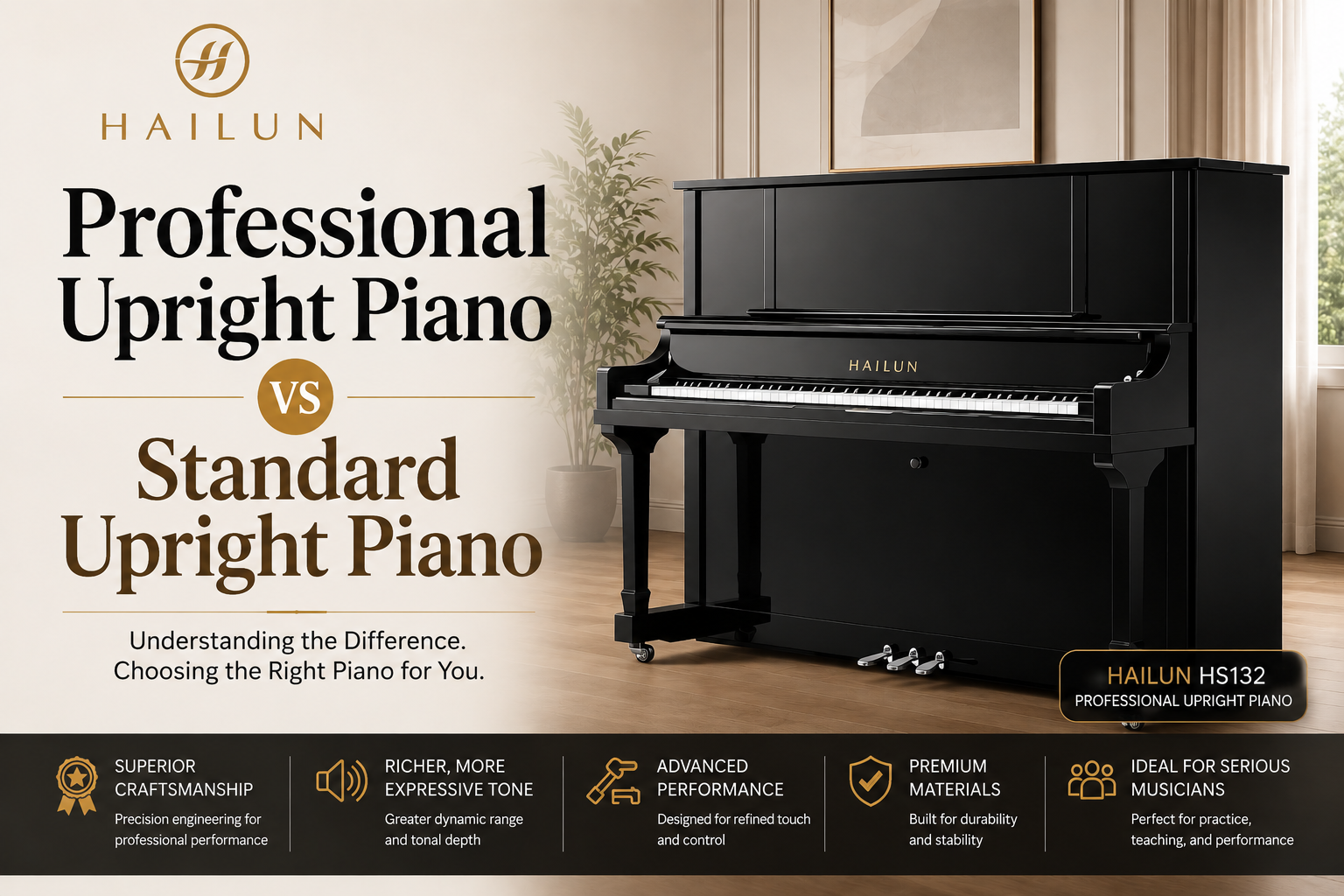
Professional Upright Piano vs Standard Upright Piano
When shopping for an acoustic piano, you’ll often come across two common categories: standard upright pianos and professional upright pianos. While both share the same vertical design, they are built with different priorities in mind. Understanding these differences can help you choose a piano that suits your musical goals, available space, and budget.
Whether you’re a beginner, a serious student, a piano teacher, or an experienced performer, selecting the right upright piano is an important decision. Both standard and professional upright pianos have their own strengths, and the right choice depends on how and where the instrument will be used.
In this guide, we’ll explain the differences between professional upright pianos and standard upright pianos, and use the Hailun Piano HS132 as an example of a professional upright model.
What Is a Standard Upright Piano?
A standard upright piano is the most common type of acoustic piano found in homes, schools, and music classrooms. These pianos are designed to provide a balance between sound quality, size, and affordability.
Most standard upright pianos range from 110 cm to 128 cm in height. Their compact dimensions make them suitable for apartments, condominiums, and family homes where space is limited.
A standard upright piano is often chosen by:
- Beginners
- Families purchasing their first acoustic piano
- Students taking piano lessons
- Casual home musicians
- Music schools with limited space
Despite their smaller size, quality standard upright pianos are capable of producing a warm, expressive sound and can support students well beyond the beginner stage. Many pianists complete graded examinations and continue playing for years on a standard upright.
What Is a Professional Upright Piano?
A professional upright piano is generally taller and incorporates design features intended to provide greater tonal depth and a broader range of expression.
Professional upright pianos typically measure 130 cm to 132 cm in height.
The larger cabinet allows manufacturers to install:
- Longer strings
- A larger soundboard
- Larger bridges
- More internal space for sound development
These design differences can influence the piano’s tone, resonance, and responsiveness.
Professional upright pianos are commonly found in teaching studios, conservatories, music institutions, churches, and performance venues. Many premium piano manufacturers, including Hailun Piano, offer professional upright models designed for pianists who want the performance of a larger instrument while retaining the practicality of an upright piano.
Cabinet Height
One of the most noticeable differences between the two types is cabinet height.
A standard upright piano generally stands between 110 and 128 cm, while a professional upright piano usually measures between 130 and 132 cm.
The extra height is not simply for appearance. It creates additional internal space that allows for longer strings, a larger soundboard and a larger action mechanism.
That said, cabinet height alone should not be used to judge the overall quality of a piano. The condition of the instrument, the quality of its construction, and proper maintenance all play an important role in how it performs. Whether you’re considering a Hailun Piano, Kawai, Yamaha, or another reputable brand, regular servicing and proper care are just as important as the piano’s size.
String Length
Professional upright pianos often have longer strings than standard upright models.
Longer strings can contribute to:
- A fuller bass response
- Greater tonal richness
- Longer sustain
- Smoother transitions across the keyboard
However, the difference may be more noticeable to experienced players than beginners. A well-built standard upright piano can still produce a pleasing, balanced sound that is more than adequate for daily practice and lessons.
Soundboard Size
The soundboard is responsible for amplifying the vibrations produced by the strings.
Because professional upright pianos generally have taller cabinets, they often include larger soundboards. This may result in greater resonance and a broader tonal character.
Standard upright pianos, on the other hand, often produce a focused and balanced tone that works particularly well in smaller rooms where excessive volume is unnecessary.
Neither approach is inherently better—the preferred sound depends on the player’s taste, the room environment, and the design philosophy of the manufacturer. Many Hailun Piano models, for example, are engineered to achieve a warm, balanced tone while offering excellent clarity across the keyboard.
Keyboard Action and Playing Experience
Both standard and professional upright pianos can offer excellent keyboard action when properly regulated and maintained.
Professional upright pianos may provide greater consistency and responsiveness during demanding passages, which can be appreciated by advanced students, teachers, and experienced performers.
For beginners and recreational players, however, a quality standard upright piano often provides all the responsiveness needed to develop proper technique and musical expression.
In many cases, the preparation and maintenance of the piano have a greater impact on the playing experience than its overall size. This is one reason why choosing a trusted Hailun Piano dealer or an experienced piano specialist is just as important as selecting the model itself.
Example: Hailun Piano HS132 Professional Upright Piano
A good example of a professional upright piano is the Hailun Piano HS132.
Standing at 132 cm, the HS132 is designed to maximise the advantages of a taller upright piano while maintaining the space-saving footprint of a vertical instrument.
Its larger cabinet accommodates longer bass strings and a larger soundboard, allowing it to produce a rich, balanced tone with excellent clarity across the keyboard. The responsive action also makes it suitable for a wide variety of repertoire, from beginner exercises to more advanced works.
The Hailun Piano HS132 is commonly selected by:
- Music teachers
- Serious students
- Conservatories
- Churches
- Home pianists looking for a premium upright piano
While the HS132 demonstrates the characteristics often associated with a professional upright piano, it is simply one example within this category. Hailun Piano offers a range of upright models to suit different playing styles, room sizes, and musical needs.
Which Type of Piano Should You Choose?
The answer depends on your individual needs rather than the category itself.
A standard upright piano may be the ideal choice if you:
- Are buying your first acoustic piano
- Have limited space
- Want an instrument for regular home practice
- Prefer a compact cabinet
- Are working within a specific budget
A professional upright piano may be worth considering if you:
- Practise for several hours each day
- Teach piano professionally
- Enjoy a larger, more resonant sound
- Need greater tonal projection
- Plan to keep the piano for many years
Ultimately, there is no single “best” option. A high-quality standard upright piano can provide an excellent musical experience, while a professional upright piano offers additional features that some players may value depending on their playing style and goals.
Final Thoughts
Choosing between a professional upright piano and a standard upright piano is not about deciding which one is universally better. Instead, it is about finding the instrument that best suits your lifestyle, musical ambitions, available space, and budget.
A standard upright piano remains an excellent choice for beginners, families, and many experienced pianists. Professional upright models, such as the Hailun Piano HS132, offer different design characteristics that may appeal to players seeking a larger acoustic sound and greater tonal depth.
Whether you are considering a Hailun Piano or another respected piano brand, spending time comparing different upright pianos in person is always worthwhile. Listening to the tone, feeling the keyboard action, and experiencing different cabinet sizes firsthand will help you choose a piano that inspires you to play and supports your musical journey for many years to come.


