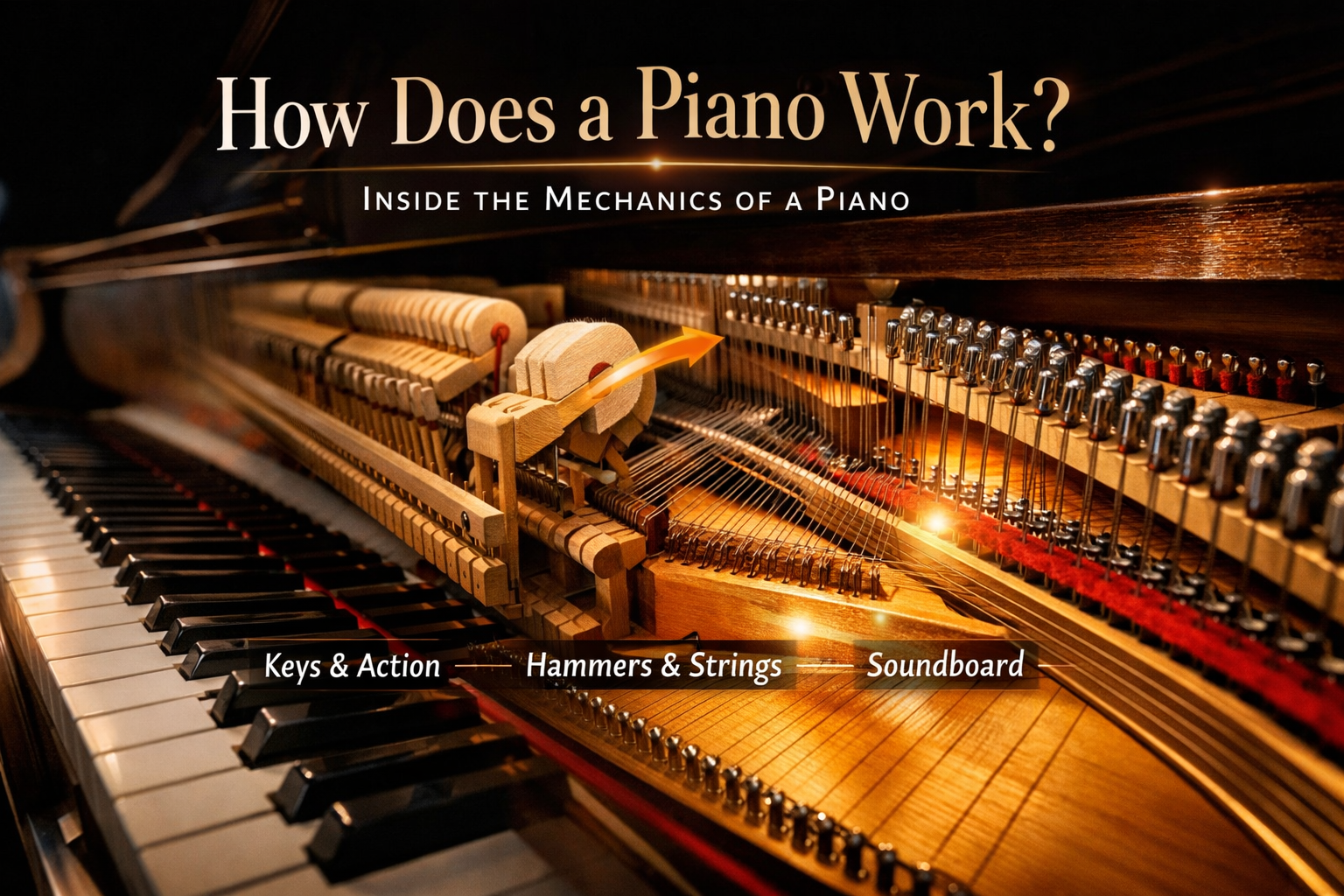
How Does a Piano Work? Inside the Mechanics of a Piano
When you press a piano key, beautiful music fills the room—but have you ever wondered what actually happens inside the instrument? Understanding how a piano works not only deepens your appreciation for the instrument, but also helps you choose the right model, especially when considering premium brands like Hailun Piano.
In this guide, we’ll explore the full mechanics of a piano—from key to hammer to string—and take a closer look at the craftsmanship found in a Hailun Piano.
The Basic Principle: Sound of Hailun Piano
At its core, a piano is a stringed percussion instrument. While it may look like a keyboard instrument, sound is actually produced when small felt-covered hammers strike tightly stretched strings.
Here’s the basic process:
-
You press a key.
-
The key activates a complex lever system called the piano action.
-
A hammer strikes the string.
-
The string vibrates.
-
Vibrations travel through the soundboard.
-
The sound is amplified and projected outward.
This entire process happens in a fraction of a second.
Step-by-Step: Inside the Mechanics of a Piano
1. The Piano Keys
A standard piano has 88 keys—52 white and 36 black. Each key is connected to a lever system. When you press down on a key, the back of the key lifts upward, activating the action mechanism.
Higher-quality pianos, including a Hailun Piano, are designed with carefully balanced keys to ensure smooth response and consistent touch.
2. The Piano Action
The piano action is one of the most intricate mechanical systems in any musical instrument. It includes over 5,000 moving parts in a grand piano.
When a key is pressed:
-
The wippen (a small lever) moves upward.
-
The jack pushes the hammer toward the string.
-
Just before striking, the jack releases, allowing the hammer to hit freely.
-
The hammer immediately falls back so the string can vibrate.
Premium manufacturers like Hailun Piano are known for precise action engineering, often incorporating high-quality materials to improve durability and responsiveness.
3. The Hammers
Piano hammers are covered in dense felt and are responsible for striking the strings. The speed at which the hammer hits the string determines the volume:
-
Soft press = quiet sound
-
Hard press = loud sound
In well-crafted instruments such as a Hailun Piano, hammer felt is carefully voiced and shaped to create a balanced tone across all registers.
4. The Soundboard
The soundboard is often called the “heart” of the piano. Made from high-quality spruce, it amplifies the string vibrations.
Without the soundboard, the strings would produce only a faint sound. The vibration transfers from the strings to the bridge, then to the soundboard, which resonates and fills the room with sound.
High-end instruments—including many Hailun Piano models—feature carefully crafted soundboards designed for optimal resonance and projection.
How Upright and Grand Pianos Differ Mechanically
While both types operate on the same principle, there are mechanical differences.
Grand Piano
-
Horizontal string layout
-
Gravity helps hammers reset quickly
-
More responsive action
Upright Piano
-
Vertical string layout
-
Uses springs to return hammers
-
More compact design
Many musicians choose a Hailun Piano in either upright or grand form because of its balanced action and tonal clarity.
Why Piano Mechanics Matter
Understanding how a piano works helps you:
-
Choose a better instrument
-
Maintain it properly
-
Improve your playing technique
-
Appreciate craftsmanship
When shopping for a piano, internal construction quality matters just as much as exterior appearance. A well-built action ensures accurate repetition, dynamic control, and long-term reliability.
Brands like Hailun Piano have gained recognition for blending traditional craftsmanship with modern manufacturing technology.
The Role of Craftsmanship in Hailun Piano Performance
Not all pianos are built the same. The materials used in the action, soundboard, and strings directly impact tone and durability.
For example, a carefully engineered Hailun Piano incorporates:
-
Precision action components
-
High-grade soundboard materials
-
Consistent key weighting
-
Detailed hammer voicing
These factors contribute to responsive touch and rich tonal color.