What Is a Piano Overhaul? Complete Owner’s Guide
A piano is a long-term investment and, with proper care, can last for generations. However, like any complex mechanical instrument, it experiences wear and tear over time. When regular tuning and minor repairs are no longer enough to maintain performance, a piano overhaul may be the best solution.
In this guide, you’ll learn what a piano overhaul is, what it includes, when it’s needed, and how it can restore your instrument’s sound and touch.
What Is a Piano Overhaul?
A piano overhaul is a comprehensive mechanical and structural refurbishment designed to restore the instrument’s performance, tone quality, and reliability.
Unlike routine maintenance such as tuning or regulation, an overhaul addresses major worn components inside the piano. The goal is not necessarily to make the piano “like new” cosmetically, but to significantly improve how it plays and sounds.
Think of it as the equivalent of a major service for a car — replacing parts that have reached the end of their lifespan so the instrument can continue performing at a high level.
What Does an Overhaul Include?
The exact scope depends on the piano’s condition, age, and budget, but most overhauls involve several key areas:
1. Action Rebuilding
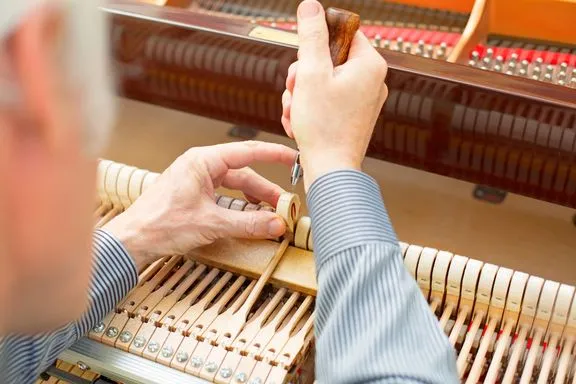
The action is the heart of the piano’s playing mechanism. Over time, parts compress, loosen, or wear out.
Common action work includes:
Replacing worn hammer felt
Installing new shanks or flanges
Reconditioning or replacing key bushings
Adjusting regulation for proper touch
This step greatly improves responsiveness and control.
2. Hammer Replacement or Reshaping
Hammers strike the strings thousands of times, causing grooves and hardening.
During an overhaul:
Severely worn hammers are replaced
Moderately worn hammers may be reshaped and voiced
This restores a clearer, more balanced tone.
3. Regulation and Voicing
After mechanical work, technicians carefully adjust the piano to ensure consistency.
This includes:
Key leveling
Touch weight balancing
Tone shaping (voicing)
These refinements make the instrument more expressive and even across all notes.
4. Structural and Hardware Work
Depending on the piano, additional repairs may be done, such as:
Replacing worn felts and leather parts
Repairing pedals and trap work
Tightening or replacing loose hardware
Piano Overhaul vs Piano Repair
Understanding the core differences helps clarify which service your piano needs.
Scope of Work
- Overhaul addresses the entire internal system.
- Repair focuses on individual problems.
Signs Your Piano Needs an Overhaul
Not every aging piano requires major work. Here are common indicators that an overhaul may be worthwhile:
Uneven or sluggish key response
Noticeable loss of dynamic control
Dull or harsh tone
Frequent regulation issues
Excessive mechanical noise
The piano is 20–40+ years old with heavy use
If you notice several of these symptoms, a professional assessment can determine whether an overhaul is cost-effective.
Benefits of a Piano Overhaul
1. Improved Touch and Control
Replacing worn parts restores precision, making the piano easier and more enjoyable to play.
2. Better Tone Quality
New or reconditioned hammers and proper voicing bring back warmth, clarity, and balance.
3. Extended Lifespan
An overhaul can add decades of useful life, especially for well-built instruments.
4. Cost-Effective Alternative to Replacement
For many mid- to high-quality pianos, an overhaul costs significantly less than buying a new instrument of similar quality.
How Long Does an Overhaul Last?
With proper maintenance, the results typically last 15 to 25 years, depending on usage and environment. Regular tuning and periodic regulation will help preserve the improvements.
How Much Does a Piano Overhaul Cost?
Costs vary widely depending on the piano type and extent of work, but general ranges are:
Upright piano: mid four-figure range
Grand piano: higher due to complexity
A detailed inspection is necessary for an accurate quote.
Is a Piano Overhaul Worth It?
An overhaul is usually worthwhile if:
The piano has good structural integrity
It holds tuning reasonably well
It has sentimental or musical value
Replacement cost would be much higher
However, if the soundboard has major issues, a full restoration or replacement may be more practical.
Final Thoughts
A piano overhaul is one of the most effective ways to breathe new life into a well-loved instrument. By renewing critical mechanical parts and refining the touch and tone, it can transform a tired piano into a responsive, expressive instrument once again.
If you’re unsure whether your piano needs an overhaul, consider scheduling a professional evaluation. Understanding your piano’s condition is the first step toward preserving its sound for years to come.